
Lyubcho Varamezov
Tsenov Academy of Economics, Svishtov, Bulgaria
Simeonka Petrova
Tsenov Academy of Economics, Svishtov, Bulgaria
Lyubomira Todorova
Tsenov Academy of Economics, Svishtov, Bulgaria
Yavor Stanev
Tsenov Academy of Economics, Svishtov, Bulgaria
https://doi.org/10.53656/igc-2025.02

Pages 20-31
Abstract. The primary aim of the article is to examine and interpret the correlation between technological innovations and the sustainable development of the economic activities of SMEs in the European Union member states during the period 2012–2022. The adopted methodological framework of the study includes the application of the linear regression and correlation method. The similarities and differences in the innovativeness of the studied enterprises in the European Union member states are highlighted. Key patterns in the development of technological innovativeness at the enterprise level in the European food industry are identified.
Keywords: technological innovations; sustainable development; European SMEs; food industry
JEL: L16, O14, O32
Introduction
The food industry plays an important role in the global economy and occupies a significant position in the manufacturing industry of Europe (Mitkova, 2025). Among the key indicators of its socio-economic importance are the number of enterprises, the gross domestic product (GDP), and the employment provided. In 2022, the sector recorded over 273843 operating enterprises, representing 14.50% of the total structure of the manufacturing industry in the 27-member states of the European Union (Eurostat, 2025). The sector contributes 1.60% to the GDP of the European economy. The largest share of enterprises in food production is held by SMEs, accounting for more than 99.15% (Eurostat, 2025). The total number of employees exceeds 4.7 million people, accounting for 15.70% of those employed in the manufacturing industry (Eurostat, 2025).
The ability of SMEs in the food industry to develop sustainably is largely linked to the creation of innovations, some of which are technological innovations. Previous studies emphasise that determining technological innovations requires distinguishing between product and process innovations, while at the same time recognising the existing interrelation between them (Rogers, 2004). Implemented technological processes stimulate the production of innovative products.
The transformation processes involving the introduction of modern business technologies aligned with sustainability principles pose substantial challenges and difficulties for European SMEs in the manufacturing sector of food production. In the annual report of the European Commission on SME performance in 2022, valuable findings are presented regarding the opportunities and constraints faced by these enterprises. According to analyses conducted by the Commission, recent years have been characterised by the adverse impact of the Covid-19 pandemic, difficulties in hiring highly qualified personnel, inflation, rising costs of energy and raw materials, and limited financial resources (European Commission, 2023). At the same time, the cited report highlights positive correlations between technology-intensive SMEs and increases in added value, employment, and the number of enterprises.
In this regard, the present study adopts the view that technological innovations are among the key instruments for the sustainability of economic development of European SMEs in the food industry. The main objective of the article is to examine and interpret the correlation between technological innovations and the sustainable development of the economic activity of SMEs in the member states of the European Union during the period 2012 – 2022. On this basis, the similarities and differences in the technological innovation behaviour of the studied enterprises across the European countries are identified, and more significant patterns are outlined.
The multifaceted nature of the researched issue requires the introduction of certain restrictive conditions: placing emphasis on the economic dimension of sustainable development of European SMEs in the food industry, compared to the social and environmental dimension.
Literature Review
The sustainable transformation of European SMEs in the food industry plays a key role in achieving the Sustainable Development Goals. In recent years, this has attracted the attention of scholars, practitioners, and specialists (Venturelli et al., 2022). The importance and significance of this industry for the sustainable development of the European economy are reflected in its contribution to addressing food shortages caused by rapid population growth, to reducing food waste, which has become a serious environmental, economic, and social problem, to mitigating climate change and conserving natural resources, as well as to improving living standards (Martin-Rios et al., 2018; Rabadan et al., 2019).
The sustainable development of SMEs in Europe’s food industry sector and the achievement of better economic, environmental, and social outcomes require an increase in the innovativeness of food companies, as well as the development and offering of healthier and higher-quality food products (Leon‐Bravo et al., 2019). Innovation could also improve the environmental friendliness of a number of productions, lead to the saving of resources and energy, at the same time – improving the market positions of the companies that apply them (Pavlov & Kurshumov, 2025). The decisive importance of innovations, and in particular technological innovations, for achieving sustainability, creating value, gaining and maintaining the competitive advantage of SMEs, as well as improving productivity, is widely recognised in the specialised literature (Baden-Fuller & Haefliger, 2013; Jeong et al., 2020). The innovation imperative is very strong for enterprises in the sector under consideration and plays a key role in maintaining and enhancing their competitiveness (Capitanio et al., 2010).
Although the food industry has traditionally been considered not particularly innovative, researchers’ interest in innovations in this sector has increased in recent years (Bigliardi et al., 2020). The food industry is the largest manufacturing sector in terms of turnover and added value and one of the most important branches driving the European Union’s economy, playing a central role in processing agricultural raw materials and ensuring food security for the population (Menrad, 2004; Bayona-Saez et al., 2017). Moreover, the food sector has strong links with various other industries such as agriculture, the chemical industry, pharmaceuticals, and others. European SMEs in the food industry tend to rely heavily on supplies from local industries and services (Avermaete et al., 2004).
The technological innovations – both product and process – introduced by SMEs in Europe’s food industry sector have a positive impact on the environment, employment, and consumption, while also leading to reduced production or transport costs. In this way, these types of innovations acquire not only economic significance, but also environmental and social dimensions (Leon‐Bravo et al., 2019). For instance, product innovations play an important role in responding to changes in demand patterns that are oriented towards product qualities, including healthy food, seasonal characteristics, convenience, and new formats, both for traditional and for specialised products.
Some researchers argue that European SMEs in the food sector tend to focus more on incremental rather than radical innovations (Baregheh et al., 2012). Companies in the food sector are cautious about how end consumers might react to radically new products. In addition, compliance with legal requirements related to safety and consumer protection makes innovations in food products and processes a complex, time-consuming, and risky endeavour (Galizzi & Venturini, 1996). It is also noted that European consumers are generally conservative in their food choices, often rejecting new food products.
A number of academic studies link the motivation and opportunities for implementing product and process innovations to the size of enterprises. It is widely recognised that large companies possess resources far exceeding those of SMEs. In their study on the implementation of product and process innovations in twelve food industry companies across six European countries, W. Traill and M. Meulenberg (2002) conclude that the innovative behaviour of these companies is predominantly determined by their size and the nature of their ownership. Another study conducted in 2006 among SMEs in Germany’s food industry also found that large companies outperform SMEs in the number of technological innovations implemented, with a ratio of 63.00% to 37.00% (Feigl & Menrad, 2008). There are also numerous research claims suggesting that SMEs possess several behavioural advantages compared to large companies (Grunert et al., 1997). This enables them to respond more quickly to emerging market changes due to less bureaucracy, a simplified and focused organic organisational structure, as well as higher levels of commitment and motivation among managers. It is confirmed that SMEs face greater competition, which further necessitates their timely and appropriate responses.
Thus, the conceptual considerations and interpretations regarding the opportunities for implementing technological innovations highlight the existing difficulties, problems, and challenges faced by European SMEs in the food processing sector. This defines the research interest in the outlined topic.
Methodology
This study draws on data from the Eurostat. Within the framework of the adopted econometric model, the dependent variable used to assess the types of technological innovations implemented is: “business process innovations by improving the production methods of European SMEs in the food industry”. For the purposes of the analysis, the unit of measurement of this variable is in numbers and is in line with the annual data published by Eurostat.
The following independent variables were selected: the amount of net turnover and the amount of R&D expenditure of the surveyed enterprises. In turn, the amount of net turnover is used as a measure of the sustainable development of the economic activity of the European SMEs in the food industry, defined as the object of the study. Ensuring comparability of the net turnover data is achieved by deflating nominal values with the annual inflation index at the European Union level. The second independent variable is reduced to the amount of: „research and development expenditures“ of the surveyed enterprises, the unit of measurement being a percentage of the Gross Domestic Product (GDP).
It is necessary to clarify that the analysis of the data for the three selected variables is based on aggregated annual data at the European Union level. The specified time scope of the study is the period 2012-2022, for which statistical data are available. The methodological framework of the study includes analysing and assessing the emerging dependence of business process innovations through improving the production methods of European SMEs in the food industry on the size of net turnover and research and development expenses. The method of linear regression and correlation is applied. The variables are tested for multicollinearity.
Statistics software product and the Excel program are used. For the purpose of the study, a null and alternative hypothesis are adopted, which are reduced to:
H0: There is no dependence of the business process innovations carried out by improving production methods on the amount of net turnover and the amount of research and development expenses of European SMEs in the food industry.
H1: There is a dependence of the business process innovations carried out through the improvement of production methods on the amount of net turnover and the amount of research and development expenses of European SMEs in the food industry.
Results
The available statistical data for the period 2012–2022 on the state and dynamics of the net turnover achieved by SMEs in the food manufacturing sector make it possible to identify a positive growth trend in the variable under analysis. Ensuring comparability of the data for the variable is achieved by deflating the nominal values with the annual inflation index at the European Union level. In 2022, the reported increase compared to the base year is more than 1.40 times (see Fig. 1).
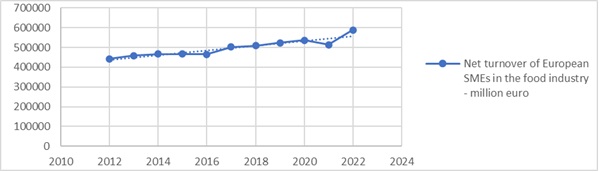
Figure 1. Dynamics during the period 2012 – 2022 of the net turnover of SMEs in the food industry of the 27 Member States of the European Union, million euro
Source: Designed by the authors
The change in the value of net turnover of European SMEs in the food processing sector allows for the determination of the growth rate and the average annual growth rate: see Table 1.
Table 1. Change in total net turnover of SMEs in the food industry in the 27 Member States of the European Union during the period 2012-2022
| Region | Growth rate
(2022/2012) |
Average annual growth rate
(2022/2012) |
| EU-27 | 0.4497 | 1.0378 |
Source: Eurostat – sbs_part_xrtvc, and author’s calculations
In the period 2012 – 2022, the growth rate of the total net turnover of European SMEs in the food processing sector amounted to 0.4497. This reported value reflects the development dynamics of the analysed variable over the ten-year study period. The second indicator has a value of 1.0378 and represents the average annual growth rate. Its practical use lies in measuring the average speed of development. Over the entire period, there was a positive increase in the value of the total net turnover of European SMEs in the food industry by a factor of 1.0378.
The study and comparison of SMEs in the food industry sector of the European Union countries allow us to synthesize that significant variations occur. For example, during the analyzed period 2012 – 2022, according to the reported net turnover, the surveyed enterprises in Italy, Germany and France achieved higher values compared to the average values for the European Union. The highlighted countries have relative shares in the total number of business process innovations carried out by improving the production methods of SMEs in the food industry of Europe, amounting to: 20.79%, 16.25% and 10.13%. In Malta and Romania, relatively lowest values of the thus assessed indicator are reported. As more important reasons, as a result of which the differences between the countries with high and low results occur, the following can be indicated: differences in innovation support policies; unequal access to financing; differences in cultural attitudes towards innovations; differences in regulatory burdens and others.
Conducting a linear regression analysis provides grounds to examine the dependence of the variable „business process innovations by improving the production methods of European SMEs in the food industry“ on the „size of net turnover“ and „expenditures on research and development“ of the studied enterprises. This ensures reaching certain research results, which are visualized through the following tables. With the help of Table 2, significant indicators of regression statistics are illustrated. The values of the correlation and determination coefficients are presented.
Table 2. Model Summary
| R | R Square | Adjusted
R Square |
Std. Error of the Estimate | Durbin-Watson |
| 0.993a | 0.978 | 0.983 | 198.43360 | 2.250 |
| a. Predictors: (Constant), Research and development expenditure – percentage of Gross Domestic Product (GDP), Net turnover of European SMEs in the food industry – million euro. | ||||
Source: Eurostat – inn_cis8_spec, inn_cis13_spec, rd_e_gerdtot, and author’s calculations
According to the data in the table, the multiple correlation coefficient (R) takes the value 0.993. The usefulness of this coefficient is that it measures the strength of a multiple linear relationship between the analysed variables. Since 0.7 < R = 0.993 < 1, a strong or high degree of dependence of the outcome variable of the implemented “business process innovations by improving the production methods of European SMEs in the food industry” on the two predictors: „the size of net turnover“ and “expenditures on research and development” of the studied enterprises is established.
The value of the coefficient of determination (R2) amounts to 0.978 and allows us to conclude that the model explains a significant part of the variation in the measured type of technological innovation of the studied SMEs in the production of food products. Therefore, a significant part of the differences in the type of business process innovations implemented by European SMEs in the food industry is explained by the differences between them in the reported: “net turnover” and “expenditure on research and development”. The data in the same table also shows the value of the specified coefficient of determination, which takes the favourable value of 0.983. The empirical value of the Durbin-Watson Test is between 1.500 and 2.500, which means that it is in the normal range.
The following table allows us to estimate the explained variance of the dependent variable: see Table 3.
Table 3. ANOVA
| Sum of Squares | df | Mean Square | F | Sig. | |
| Regression | 23385461.409 | 2 | 11692730.704 | 96.952 | 0.000b |
| Residual | 315007.137 | 8 | 39375.892 | ||
| Total | 23700468.545 | 10 | |||
| a. Dependent Variable: Business process innovation by improving production methods of European SMEs in the food industry – number.
b. Predictors: (Constant), Research and development expenditure – percentage of Gross Domestic Product (GDP), Net turnover of European SMEs in the food industry – million euro. |
|||||
Source: Eurostat – inn_cis8_spec, inn_cis13_spec, rd_e_gerdtot, and author’s calculations
When assuming the condition that the risk of a first-order error is 5% (ɑ = 0.05), the F – criterion, as a method of verification, assumes the value 96.952. This allows us to conclude that the explained variance of the variable “business process innovations by improving the production methods of European SMEs in the food industry” is over 96 times greater than the error variance. For the level of significance, it is valid that Sig. = 0.000 < 0.05 = ɑ. Therefore, there is reason to reject the null hypothesis. In this way, a regular dependence of the analyzed variable on the selected two factor quantities is established – the amount of net turnover and expenses for research and development of the studied enterprises.
The data in Table 4 illustrate the regression coefficient of the independent variable under analysis.
Table 4. Coefficients
| Unstandardized Coefficients | Standard.
Coeffici–ents Beta |
t | Sig. | 95.0% Confidence Interval for B | |||
| B | Std. Error | Lower
Bound |
Upper Bound | ||||
| (Constant) | -19387.46 | 1514.80 | -12.799 | 0.000 | -22880.61 | -15894.32 | |
| Net turnover of European SMEs in the food industry – million euros | 0.005 | 0.002 | 0.176 | 2.598 | 0.032 | 0.001 | 0.009 |
| Research and development expenditure – percentage of Gross Domestic Product (GDP) | 18986.875 | 1516.59 | 0.847 | 12,519 | 0.000 | 15489.604 | 22484.146 |
| a. Dependent Variable: Business process innovation by improving production methods of European SMEs in the food industry – number. | |||||||
Source: Eurostat – inn_cis8_spec, inn_cis13_spec, rd_e_gerdtot, and author’s calculations
The interpretation of the numerical values of the partial regression coefficients of the two factor variables allows us to reach certain conclusions. The empirical characteristics of the analyzed variables are in the range from 0.005 to 18986.875. This means that with an increase in their values, an increase in the resulting variable with the corresponding size is observed.
The data in the table also present the confidence intervals of the model parameters. The following is established: the parameter β1 with a 95% confidence level. This means that with a 95% confidence levl, it can be assumed that the parameter β1 of the regression equation for the sample is a number in the range between 0.001 and 0.009 million euros; the parameter β2 with a guarantee probability of 95%, this means that with a confidence probability of 95% it is considered that the parameter β2 of the regression equation for the sample is a number in the interval between the specified values.
Discussion
The research results thus obtained provide grounds to report a strong or high degree of dependence of the outcome variable of the implemented „business process innovations by improving the production methods of European SMEs in the food industry“ on the two predictors: „the size of the net turnover“ and „expenditures on research and development“ of the studied enterprises. Conducting a linear regression analysis allows for the interpretation of innovative changes occurring in SMEs of the 27 Member States of the European Union operating in the food production sector. The specific focus placed on the studied type of technological innovation allows for the measurement of their dependence on the selected factor variables.
Within the delineated research domain, there is scope for discussion. It is both relevant and practically valuable to compare the findings with those of other researchers and expert opinions published in specialised literature. For instance, in scholarly works dedicated to the challenges and opportunities facing the innovative behaviour of European SMEs, several key determinants are identified: limited financial resources for implementing innovations at the production, organisational, and other levels; inefficient management of research and development expenditures; barriers to accessing international markets, etc. (Hansen & Nybakk, 2016). These highlighted issues necessitate the systematic development of policies that promote the enhancement of the innovative potential of the enterprises under study.
Conclusions
The analysis of technological innovativeness in European SMEs within the food manufacturing sector allows for certain conclusions and generalisations to be drawn. Within the food industry in the 27 Member States of the European Union, a positive correlation has been established between business processes implemented through the improvement of production methods, on the one hand, and, on the other hand, the size of the net turnover and the amount of research and development expenditure of European SMEs in the food industry. Based on the conducted linear regression analysis, a group of countries – Italy, Germany, and France – emerge as achieving values above the average, whereas other countries – Malta and Romania – record comparatively the lowest values. Of practical significance is the assessment that a significant part of the differences in the type of business process innovations implemented by European SMEs in the food industry is explained by the differences between them in the reported amount of net turnover and the costs incurred for research and development. Therefore, technological innovations can be determined as one of the key tools for achieving the desired sustainable development of the economic activity of small and medium-sized enterprises in the food production sector in Europe. The empirical results thus obtained are useful for managers assisting and promoting the sustainable development of European SMEs in the food industry through technological innovations.
Acknowledgement
We would like to express our gratitude to the Research Institute of the Dimitar A. Tsenov Academy of Economics – Svishtov for the financial support of research project No. 2-2025, titled “Study of the Impact of Innovations on the Sustainable Development of Small and Medium-Sized Enterprises.”
References
Avermaete, T., Viaene, J., Morgan, E., Pitts, E., Crawford, N., & Mahon, D. (2004). Determinants of product and process innovation in small food manufacturing firms. Trends in food science & technology, 15(10), 474 – 483.
Baden-Fuller, C., & Haefliger, S. (2013). Business models and technological innovation. Long range planning, 46(6), 419 – 426. https://doi.org/10.1016/j.lrp.2013.08.023.
Baregheh, A., Rowley, J., Sambrook, S., & Davies, D. (2012). Innovation in food sector SMEs. Journal of Small Business and Enterprise Development, 19(2), 300 – 321. https://doi.org/10.1108/14626001211223919.
Bayona-Saez, C., Cruz-Cazares, C., Garcia-Marco, T., & Sanchez Garcia, M. (2017). Open innovation in the food and beverage industry. Management Decision, 55(3), 526 – 546. https://doi.org/10.1108/MD-04-2016-0213.
Bigliardi, B., Ferraro, G., Filippelli, S., & Galati, F. (2020). Innovation models in food industry: a review of the literature. Journal of technology management & innovation, 15(3), 97 – 108. https://doi.org/10.4067/S0718-27242020000300097.
Capitanio, F., Coppola, A., & Pascucci, S. (2010). Product and process innovation in the Italian food industry. Agribusiness, 26(4), 503 – 518. https://doi.org/10.1002/agr.20239.
European Commission. (2023, 10 July). How are European SMEs doing? Insights from the SME performance review. https://single-market-economy.ec.europa.eu/news/how-are-european-smes-doing-insights-sme-performance-review-2023-07-10_en.
Eurostat. (2025, May 14). Enterprise statistics by size class and NACE Rev. 2 activity (from 2021 onwards). https://ec.europa.eu/eurostat/databrowser/view/sbs_sc_ovw__custom_17163899/default/table?lang=en.
Feigl, S., & Menrad, K. (2008). Innovation activities in the food industry in selected European countries. Project report “Traditional United Food Europe” (TRUEFOOD). https://doi.org/10.13140/RG.2.2.22364.41608.
Galizzi, G., & Venturini, L. (1996). Product innovation in the food industry: Nature, characteristics and determinants. In G. Galizzi, & L. Venturini (Eds.) Economics of innovation: The case of food industry (pp. 133 – 153). Physica-Verlag.
Grunert, K., Harmsen, H., Meulenberg, M., Kuiper, E., Ottowitz, T., Declerck, F., Traill, B., & Göransson, G. (1997). A framework for analysing innovation in the food sector. In B Traill & K. G. Grunert (Eds.) Products and process innovation in the food industry (pp. 1 – 37). Springer.
Hansen, E., & Nybakk, E. (2016). When innovativeness determines market orientation: The forest sector and Great Recession. BioProducts Business, 1(1), 1 – 12.
Jeong, H., Shin, K., Kim, E., & Kim, S. (2020). Does open innovation enhance a large firm’s financial sustainability? A case of the Korean food industry. Journal of Open Innovation: Technology, Market, and Complexity, 6(4), Article 101. https://doi.org/10.3390/joitmc6040101.
Leon‐Bravo, V., Moretto, A., Cagliano, R., & Caniato, F. (2019). Innovation for sustainable development in the food industry: Retro and forward‐looking innovation approaches to improve quality and healthiness. Corporate Social Responsibility and Environmental Management, 26(5), 1049 – 1062. https://doi.org/10.1002/csr.1785.
Martin-Rios, C., Demen-Meier, C., Gössling, S., & Cornuz, C. (2018). Food waste management innovations in the foodservice industry. Waste management, 79, 196 – 206. https://doi.org/10.1016/j.wasman.2018.07.033.
Menrad, K. (2004). Innovations in the food industry in Germany. Research policy, 33(6 – 7), 845 – 878. https://doi.org/10.1016/j.respol.2004.01.012.
Mitkova, M. (2025). Contemporary challenges facing the food industry. Industrial Growth Conference Proceedings 2024, 128 – 135. https://doi.org/10.53656/igc-2024.12.
Pavlov, P., & Kurshumov, V. (2025). Eco-innovation and circular economy development. Industrial Growth Conference Proceedings 2024, 136 – 145. https://doi.org/10.53656/igc-2024.07.
Rabadan, A., Gonzalez-Moreno, A., & Saez-Martinez, F. (2019). Improving firms’ performance and sustainability: The case of eco-innovation in the agri-food industry. Sustainability, 11(20), 5590. https://doi.org/10.3390/su11205590.
Rogers, E. (2004). Networks, firm size and innovation. Small Business Economics, 22, 141 – 153.
Traill, W., & Meulenberg, M. (2002). Innovation in the food industry. Agribusiness: An International Journal, 18(1), 1 – 21. https://doi.org/10.1002/agr.10002.
Venturelli, A., Caputo, A., Pizzi, S., & Valenza, G. (2022). A dynamic framework for sustainable open innovation in the food industry. British Food Journal, 124(6), 1895 – 1911. https://doi.org/10.1108/BFJ-03-2021-0293.
Prof. Lyubcho Varamezov, PhD
ORCID iD: 0000-0003-1964-2786
Department of Industrial Business and Entrepreneurship
Tsenov Academy of Economics
2, Em. Chakarov St.
5250 Svishtov, Bulgaria
E-mail: l.varamezov@uni-svishtov.bg
Assoc. Prof. Simeonka Petrova, PhD
ORCID iD: 0000-0003-3483-0187
Department of Commerce
Tsenov Academy of Economics
2, Em. Chakarov St.
5250 Svishtov, Bulgaria
E-mail: s.petrova@uni-svishtov.bg
Assist. Prof. Lyubomira Todorova, PhD
ORCID iD: 0000-0001-5200-6170
Department of Tourism Economics and Management
Tsenov Academy of Economics
2, Em. Chakarov St.
5250 Svishtov, Bulgaria
E-mail: l.todorova@uni-svishtov.bg
Assist. Prof. Yavor Stanev, Ph.D.
ORCID iD: 0009-0001-2368-6565
Department of Industrial Business and Entrepreneurship
Tsenov Academy of Economics
2, Em. Chakarov St.
5250 Svishtov, Bulgaria
E-mail: y.stanev@uni-svishtov.bg