

Denis Sherifov
Technical University of Varna, Bulgaria
Prof. Tanya Panayotova
Technical University of Varna, Bulgaria
https://doi.org/10.53656/igc-2025.10

Pages 111-120
Abstract. This study explores the potential for integrating classical Lean principles with modern digital technologies to improve production management in the context of Industry 5.0. The combination of Lean with technologies such as artificial intelligence, the Internet of Things, and collaborative robots enables not only process optimization but also the creation of a production environment that is more flexible, adaptive, and oriented toward long-term sustainability. A conceptual integration model is proposed, aiming not only to enhance the efficiency of traditional production practices but also to increase their adaptability to a rapidly changing environment.
Keywords: lean manufacturing; Industry 5.0; intelligent automation; human-centric production; sustainability; digital transformation
JEL: L23, M11, O33
Introduction
Contemporary industry is undergoing a profound transformation driven by digitalization, sustainability requirements, and the need for human-centered production systems. In this context, enterprises must simultaneously achieve efficiency, innovation, and resilience. Lean has long been established as a leading managerial philosophy, providing tools such as Just-in-Time, Kaizen, and Value Stream Mapping to reduce waste, optimize processes, and foster a culture of continuous improvement. However, scholars note that traditional Lean applications have limitations when addressing the growing complexity of modern production systems.
In parallel, the concept of Industry 4.0 introduces a new generation of digital technologies – cyber-physical systems, the Internet of Things, artificial intelligence, big data, and advanced analytics. These technologies expand the possibilities for automation, operational transparency, and real-time decision-making. However, technological advancement alone is insufficient to ensure sustainable organizational development. For this reason, the emerging framework of Industry 5.0 emphasizes the integration of technological solutions with human competencies, viewing this synergy as fundamental for the creation of ethical, adaptive, and environmentally responsible production systems.
Against this background, the central research question of the present study arises:
How can classical Lean principles be effectively integrated with the digital technologies of Industry 5.0 so as to improve operational efficiency, sustainability, and human-centric production management?
The aim of this study is to propose and substantiate a conceptual model – “Lean + Digital Monitoring”—that combines the process discipline and waste-reduction logic inherent in Lean with contemporary digital capabilities such as real-time monitoring, predictive analytics, digital twins, and collaborative platforms. By doing so, the research demonstrates the potential to establish production systems that are resilient, transparently managed, and capable of adaptive response to change, without diminishing the essential role of the human factor.
Theorethical Foundations of LEAN
Lean represents a managerial philosophy and a production system that emerged in the Japanese automotive industry during the second half of the twentieth century, primarily through the practices of Toyota, known as the Toyota Production System (TPS) (Ohno, 1988). TPS was developed with the objective of ensuring sustainable competitive advantage by means of efficient resource utilization, minimization of waste, and the establishment of a culture of continuous improvement. At its core, Lean seeks to create maximum value for the customer through the systematic elimination of waste (muda), the leveling of production flows (heijunka), and the implementation of processes for ongoing improvement (kaizen).
The philosophy is grounded in the understanding that any activity which does not add value from the customer’s perspective should be identified and eliminated. In doing so, resources are freed, production cycles are shortened, and the overall organizational flexibility is enhanced (Womack et al., 1990). Beyond its purely instrumental application, Lean is conceived as a comprehensive management system that integrates principles, methods, and organizational culture.
– Focus on the Customer – Value Definition
– Flow optimization – building a balanced process
– The Pull principle of production
– Striving for perfection
Owing to these principles, Lean has been established not only as a production practice but also as a strategic approach to management, contributing to enhanced efficiency, quality, and long-term sustainability. Lean transcends a purely instrumental application and is perceived as a comprehensive management system that integrates principles, methods, and organizational culture. It is not merely a set of techniques, but a managerial philosophy that requires a transformation in mindset and organizational behavior. In this sense, Lean constitutes a strategic framework directed not only toward the optimization of production processes but also toward the creation of sustainable competitive advantages. A key element is the commitment of employees at all levels – from shop-floor operators to senior management. Lean promotes a culture of open communication, collective responsibility, and active involvement in processes of continuous improvement. This transforms the organization into a “learning system,” capable of responding rapidly to external changes and integrating new knowledge and practices into its daily operations (Liker, 2004). Over the long term, Lean has become consolidated as a strategic philosophy that combines the achievement of operational efficiency with the development of an organizational culture rooted in discipline, innovation, and sustainability. This dual nature – both methodological and cultural – explains why Lean continues to be a relevant and effective managerial practice across diverse industries and contexts.
Despite the proven effectiveness of Lean and its widespread adoption across various industries, the growing complexity of the contemporary business environment and the advance of digital transformation pose new challenges for organizations. Owing to globalization, the increasing demands for sustainability, and the need for rapid adaptability to dynamic market conditions, managerial approaches are required that build upon the already established Lean principles. It is precisely in this context that the concepts of Industry 4.0 and the more recent framework of Industry 5.0 have emerged. While Industry 4.0 emphasizes the deployment of digital technologies such as artificial intelligence, the Internet of Things, cyber-physical systems, and big data analytics, Industry 5.0 places an even stronger focus on a human-centered perspective.
It regards technology not as a substitute but as a partner to human capabilities, supporting creativity, decision-making, and participation in production processes. This highlights the necessity of an integrated approach in which classical Lean principles are combined with modern digital technologies to achieve sustainable, adaptive, and human-centric production. In this way, the foundation is laid for a conceptual model that unites the strengths of both paradigms and offers a solution to the challenges of contemporary industry.
Industry 5.0
Industry 5.0 emerges as an overarching framework that seeks to balance the technological achievements of Industry 4.0 with the values of sustainable and human-oriented development. The European Commission1 defines Industry 5.0 as a vision of “sustainability, resilience, and human-centricity.” It regards technology not as a substitute for humans, but as a partner that supports their creativity, expertise, and involvement in decision-making.
The main characteristics of Industry 5.0 include:
– Human-Centered Production – integrating human skills and creativity with the power of automation and digitalization (Nahavandi, 2019).
– Sustainability and the Circular economy – Implementation of “Green” Technologies, Energy Efficiency and Waste minimization (Tiwari & Khan, 2020).
– System Resilience – Developing production structures capable of rapid adaptation to cryses and market changes (Breque et al., 2021).
– Collaborative Technologies – The use of cobots, intelligent interfaces and digital twins enabling effective collaboration between humans and machines (Longo et al., 2020).
According to Nahavandi (2019), Industry 5.0 shifts the focus away from technology and emphasizes the potential for progress through fruitful collaboration between humans and machines, highlighting the importance of new competencies for the effective integration of human capital into “smart factories.” In this sense, Industry 5.0 can be regarded as an overarching paradigm that combines the technological power of Industry 4.0 with social responsibility, environmental sustainability, and human creativity. This positions it as a strategic factor for the future competitiveness of industrial organizations in Europe and worldwide (Sony, 2020; Oztemel & Gursev, 2020).
An analysis of the theoretical foundations of Lean, Industry 4.0, and Industry 5.0 demonstrates that each of these concepts possesses distinct advantages, but also certain limitations when considered in isolation. Lean offers a robust managerial framework for waste elimination, process optimization, and the cultivation of an organizational culture of continuous improvement. Industry 4.0 introduces digital technologies that open new opportunities for automation, data analytics, and operational transparency. Industry 5.0, in turn, emphasizes human orientation, sustainability, and the integration of the human factor with intelligent technologies.
Research Methodology
The research methodology underlying this study is based on a structured and sequential process that combines theoretical analysis, synthesis of existing knowledge, and conceptual model development. The starting point of the methodology was a systematic review of academic and industrial literature related to Lean management, digital transformation, and the emerging principles of Industry 5.0. This comprehensive examination enabled the identification of persistent challenges in contemporary manufacturing – such as process variability, information fragmentation, limited real-time visibility, and insufficient integration between human expertise and technological capabilities. These findings formed the conceptual basis for aligning the stabilizing, process-oriented nature of Lean with the adaptive and data-driven potential of modern digital technologies.
Building on this theoretical foundation, the next phase of the methodology focused on developing the conceptual model “Lean + Digital Monitoring.” Through comparative analysis, the study examined the extent to which classical Lean tools—such as Just-in-Time, Kaizen, and Value Stream Mapping – can be complemented by digital solutions including IoT telemetry, AI-based analytics, digital twins, and collaborative platforms. This analytical synthesis demonstrated that sustainable production transformation requires both the process stability provided by Lean and the intelligent adaptability enabled by Industry 5.0 technologies. As a result, a layered conceptual model was formulated, capturing the dynamic interaction between data input, Lean logic, digital enhancement, and organizational outcomes. The model emphasizes a continuous information flow – where raw operational data are collected, contextualized, analyzed, and fed back into decision-making cycles – thus transforming the organization from a reactive to a proactive management system.
Following the construction of the conceptual model, the methodological process culminated in the development of a roadmap intended to guide the practical implementation of the “Lean + Digital Monitoring” approach. The roadmap was elaborated through iterative refinement that combined insights from the literature, analytical mapping of Lean and digital capabilities, and expert consultations with practitioners and academic specialists. This iterative process ensured that the proposed roadmap is both theoretically grounded and aligned with real industrial constraints such as data availability, technological maturity, and organizational readiness. The resulting roadmap outlines a structured progression from data acquisition and Lean-based process stabilization to digital augmentation and, ultimately, the achievement of balanced, transparent, and human-centered production systems.
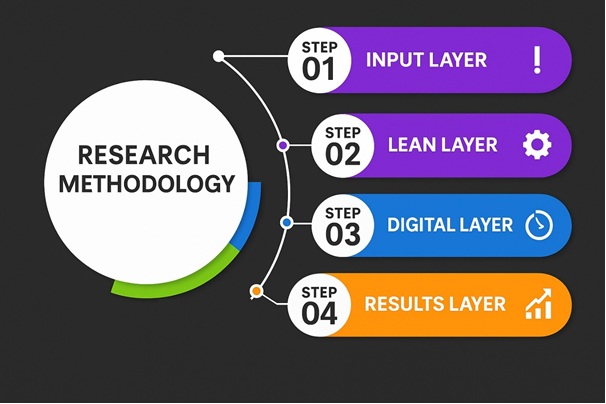
Figure 1. Research methodology
Input Layer
At the foundation of the model lies the systematic collection and structuring of production-related data. This input layer is critical, as it provides the “raw material” upon which Lean tools and digital technologies are built.
– Daily and Monthly Production Volumes – the quantities of produced units distributed over time. These indicators reflect capacity, workload, and fluctuations. For example, peak values at the beginning of a given period followed by a decline toward its end indicate unbalanced production.
– External Factors – including market demand dynamics, seasonal variations, disruptions in supply chains, or fluctuations in raw material prices. These factors directly affect production planning and must be accounted for in real time.
– Quality Indicators – including defects, downtimes, rejects, and deviations from standards. These data provide insights into process efficiency and signal the need for corrective actions.
Lean Layer
This layer applies the principles and tools of Lean to ensure discipline, order, and efficiency within the processes.
– Just in Time – ensures synchronization between production and actual demand. In this way, excess inventories and storage costs are minimized.
– Kaizen – the philosophy of continuous improvement. Every employee contributes through incremental steps to process enhancement, thereby fostering a culture of engagement and development.
– Value Stream Mapping – a tool for visualizing the flow of value. It identifies all activities, classifies them into “value-adding” and “non-value-adding,” and facilitates the planning of actions aimed at waste elimination.
Digital Layer
This layer incorporates intelligent technologies that build upon Lean and transform the organization into an adaptive and transparent system.
– IoT Sensors – installed in machines and processes, they collect data on temperature, vibrations, speed, production volume, and quality. This enables real-time monitoring.
– AI Analytics – artificial intelligence algorithms that process large volumes of data and generate forecasts, for example regarding future demand, defect probabilities, or optimal scheduling.
– Digital Twins – virtual replicas of machines or production lines that simulate different scenarios. They allow testing the effects of changes in scheduling, capacity, or resources without interrupting actual production.
– Collaborative Platforms – digital environments that facilitate interaction between humans and machines. Operators receive visualizations, recommendations, and instructions, while managers gain aggregated reports to enable faster, data-driven decision-making.
Results Layer
The interaction between Lean and digital technologies leads to substantial improvements across the entire production system.
– Balanced Production Flow – peaks and troughs are eliminated, and resources are utilized more evenly.
– Operational Transparency and Predictability – management has access to real-time data and can anticipate potential problems or opportunities.
– Cost and Waste Reduction – encompassing even “hidden” costs that would otherwise remain unnoticed, such as unnecessary movements, idle times, or defective outputs.
– Enhanced Quality and Sustainability – resulting from optimized resource utilization, minimized defects, and more effective management of energy and materials.
- Human-Centered Management – technologies support people by providing tools for faster and more informed decision-making, rather than replacing them.
Proposal for the Implementation of the Conceptual Model in Practice
The proposal for implementing the conceptual model “Lean + Digital Monitoring” in practice is aimed at achieving higher efficiency, sustainability, and competitiveness by combining proven Lean principles with modern digital technologies. Many manufacturing enterprises already have well-established traditions and processes, yet the challenges of today’s industrial environment – dynamic markets, sustainability requirements, and pressure for higher quality – demand a new approach.
The model is structured as a roadmap consisting of five sequential stages: preparation and diagnosis, implementation of Lean tools, digitalization, introduction of human-centered solutions (Industry 5.0), and strategic integration. Each stage builds upon the previous one, thereby ensuring a smooth transition from process optimization to full digital transformation and sustainable development.
In this way, practice can not only reduce costs and losses but also create a flexible and resilient production system that places both technology and the human factor at its core.
Stage 1 – Preparation and Diagnosis
– Conducting an internal audit of current processes (production, logistics, quality).
– Collection of baseline data: downtimes, defects, inventory levels, and energy consumption.
– Defining key KPIs (e.g., OEE, defect rate, downtime, productivity).
Expected outcome: a clear picture of the current state and identification of the major sources of “waste” according to Lean principles.
Stage 2 – Lean Implementation
– Applying 5S to improve workplace organization.
– Introducing Heijunka to level the production schedule.
– Implementing Just-in-Time deliveries to reduce excess inventory.
– Kaizen teams for daily improvements involving operators.
Expected outcome: more balanced processes, reduced downtimes, and improved discipline.
Stage 3 – Digitalization (from Industry 4.0 to Industry 5.0)
– Installing IoT sensors to monitor production in real time.
– Implementing AI analytics for predictive maintenance and anomaly detection.
– Creating a Digital Twin of the production line for simulation and optimization.
– Developing visual dashboards for managers and operators to ensure operational transparency.
Expected outcome: reduced downtimes, lower defect rates, and enhanced predictability.
Stage 4 – Human-Centered Approach (Industry 5.0)
– Introducing collaborative robots (cobots) for repetitive and heavy operations.
– AR/VR training programs for personnel during product line changes or the introduction of new machines.
– Developing collaborative platforms where operators can share improvement ideas.
Expected outcome: higher employee motivation, fewer errors, improved safety, and enhanced quality.
Stage 5 – Strategic Integration
– Developing a KPI dashboard that integrates indicators across all layers – Lean and Digital.
– Integration with the company’s management systems (ERP/MES).
– Regular reviews of sustainability data and environmental performance.
Conclusion
The present study is focused on the integration of Lean principles with the digital technologies of Industry 5.0. Lean provides the methodological foundation for waste elimination, discipline, and a culture of continuous improvement, while Industry 5.0 adds new dimensions—operational transparency, sustainability, and a human-centered approach.
The proposed conceptual model “Lean + Digital Monitoring” demonstrates how the combination of these two approaches enables not only process optimization but also the development of production structures that are more flexible, adaptive, and socially responsible. The model illustrates how technologies do not replace but rather complement the human factor by providing tools and data for more informed decision-making.
Its practical application, structured as a stepwise roadmap, shows the potential for tangible improvements in efficiency, quality, and competitiveness. In conclusion, it can be emphasized that the combination of Lean and Industry 5.0 should not be perceived merely as a technological enhancement, but as a comprehensive organizational transformation oriented toward the future.
NOTES
- https://research-and-innovation.ec.europa.eu/research-area/industrial-research-and-innovation/industry-50_en
References
Breque, M., De Nul, L., & Petridis, A. (2021). Industry 5.0: Towards a sustainable, human-centric and resilient European industry. The Publications Office of the European Union.
Liker, J. K. (2004). The Toyota way: 14 Management principles from the world’s greatest manufacturer. McGraw-Hill.
Longo, F., Padovano, A., & Umbrello, S. (2020). Value-oriented and ethical technology engineering in Industry 5.0: A human-centric perspective for the design of the factory of the future. Applied Sciences, 10(12), 4182. https://doi.org/ 10.3390/app10124182.
Nahavandi, S. (2019). Industry 5.0 – A human-centric solution. Sustainability, 11(16), 4371. https://doi.org/ 10.3390/su11164371.
Ohno, T. (1988). Toyota Production System: Beyond large-scale production. Productivity Press.
Oztemel, E., & Gursev, S. (2020). Literature review of Industry 4.0 and related technologies. Journal of Intelligent Manufacturing, 31, 127 – 182.
Sony, M. (2020). Industry 4.0 and lean management: A proposed integration model and research propositions. Production & Manufacturing Research, 8(1), 132 – 146. https://doi.org/10.1080/21693277.2018.1540949.
Tiwari, K., & Khan, M. S. (2020). Sustainability accounting and reporting in the Industry 4.0. Journal of Cleaner Production, 258, 120783. https://doi.org/10.1016/j.jclepro.2020.120783.
Womack, J. P., Jones, D. T., & Roos, D. (1990). The Machine That Changed the World. Free Press.
Denis Sherifov, Master
Industrial Management Department
Technical University of Varna
1, Studentska St.
9010 Varna, Bulgaria
E-mail: denis.l.sherifov@tu-varna.bg
Prof. Tanya Panayotova, PhD
ORCID iD: 0000-0001-5230-5891
Industrial Management Department
Technical University of Varna
1, Studentska St.
9010 Varna, Bulgaria
E-mail: t_panayotova@tu-varna.bg



