
Hassane Abouaïssa, Vasil Dimitrov
Artois University, Béthune, France
Todor Kableshkov University of Transport, Sofia, Bulgaria
https://doi.org/10.53656/isct-2025.21

Pages 256-265
Abstract. In the frame of intelligent transportation systems, management of traffic flow in the area surrounding cities and metropolises is an essential aspect of ensuring efficient and smooth transportation. This paper addresses a critical issue in freeway management: the effective regulation of traffic flow to alleviate daily recurrent congestion and ensure the safe circulation of goods and people. It is an effective means of reducing air pollution. The proposed strategy utilizes a two-stage control approach to address freeway ramp metering. The primary objective of ramp metering is to enhance freeway traffic conditions by regulating the inflow from the on-ramp to the highway main lane using signal lights. The first stage relies on differential flatness as a key tool for open-loop control and trajectory planning, offering a strategic approach to ensure operational efficiency. Flat systems are a generalization of linear systems (in the sense that all linear, controllable systems are flat), but the techniques used for controlling flat systems are much different from many of the existing techniques for linear systems. Differential flatness enables system inversion (and linearization) without integrating any differential equation. To handle model inaccuracies, uncertainties, and unexpected traffic demand as well as various disturbances, the second stage introduces model-free control and its corresponding intelligent controllers to close the control loop. This approach enables real-time adjustment of trajectory planning, ensuring that the system reacts effectively to changing traffic conditions. The conducted numerical simulation using real data of the North of France motorway A25, demonstrates the relevance of the proposed approach.
Keywords: Model-free control; differential flatness; freeway ramp metering; intelligent transportation systems
- Introduction
The worldwide globalization has led to an ever-increasing demand for the transportation of goods and persons. This leading to increased recurrent congestion in the areas surrounding cities and metropolises, particularly during the rush hours. In this context, intelligent transport systems (ITS) have been developed to ensure, amongst others, efficient management of traffic flows. Because of its crucial impact on the economy, safety and the environment, several measures have been proposed to improve traffic conditions on freeways. Among the most effective measurements, ramp metering has been widely developed and implemented around the word [1]. A ramp meter is a device, typically a traffic light, which uses a signal controller to regulate the flow of traffic entering freeways. Several studies devoted to this important domain of ITS have been proposed (See e.g. [2, 3, 4, 5], and the references therein). These approaches are ranging from classic proportional-integral-derivative (PID) correctors, and more modern control methods (like model predictive control – MPC, or feedback control [6, 7]) to the utilization of ordinary and partial differential equations stemming from mathematical physics, especially from fluid and statistical mechanics (see e.g. [8] and [9, 10]), as well as [11] for a recent survey of traffic flow control. It should be emphasized that ramp metering can be isolated (implemented in the vicinity of each controlled on-ramp) or coordinated (controlling several on-ramps).
Among the many feedback control algorithms which may be found in the huge literature devoted to traffic management, ALINEA (an acronym of the French wording Asservissement LINéaire d’Entrée Autoroutière [12]) is one on the very few closed-loop control syntheses which has been implemented in practice. However, these closed-loop controllers are fixed since they have no means to adapt their gains to changing conditions, and thus suffer from, e.g., uncertainties in traffic parameters and poor tuning. As stated in [1] (see e.g. [13]), one way to solve parameters uncertainties is to estimate them using Kalman filters. However, the assumption underlying the use of Kalman filters is that the parameters follow a known observable model. Moreover, these feedback methods, alongside MPC, often require a mechanism for estimating traffic state in order to respond to real-time traffic behavior.
Recent advances in artificial intelligence (AI) have paved the way for the development of more sophisticated ramp metering approaches. [1, 14] have addressed ramp metering combining MPC and reinforcement learning (RL). Other approaches that have gained substantial attention are based on RL, Deep learning (DL) and Machine learning (ML). However, methods stemming from RL imply control schemes that are tedious to implement [15]. An alternative to these various shortcomings of the algorithms has been proposed in [16]. The fundamental principle underpinning this approach is predicated on the recent advances in model-free control, whereby the mathematical model of the studied system becomes useless [17].
This paper presents work that exploits the power of two control approaches: flatness-based control and model-free control. This results in a two-stage algorithm. The first stage uses differential flatness as a key tool for open-loop control and trajectory planning, providing a strategic approach to ensure operational efficiency. The second stage relies on model-free control in a closed-loop system to address model inaccuracies, uncertainties, and perturbations. The latter, and as demonstrated by [18], is a new tool for ML and is characterized by its ease of implementation and should be substituted in control engineering to ML via Artificial Neural Networks and/or Reinforcement Learning.
This communication is organized as follow. Section 2 provides a brief overview of the macroscopic traffic flow model that is used in this paper. Section 3 is devoted to the main principles of flatness and model-free control, and their application to freeway ramp metering. Computer simulations are conducted in Section 4. Finally, some conclusions and discussions are presented in Section 5.
- Macroscopic traffic flow model
Macroscopic second-order models are the most widely used models to describe the dynamic of traffic flow along a freeway section. The initial second order model was proposed by Payne [19] and later modified by [20]. The studied model is based on the following conservation equation (as stated by several authors, the only exact equation in traffic flow modeling is the conservation one. All the others equations especially the momentum equation is principally based on empirical considerations and closely related to the specific infrastructure and traffic conditions [21]):

where ρ(x,t) and q(x,t) denote the average aggregate traffic density in units of (veh./km/lane) and the traffic volume in (veh./h), which defines the number of vehicles exiting the segment during the time period dt, respectively; g(x,t) represents the ramp generation term in (veh./h/km).
From a control theory perspective, freeway ramp metering can be viewed as a system controlled by traffic lights near the on-ramp. To derive the control law, consider the given section of freeway depicted in Fig. 1. Let ρ be the traffic density in vehicles per kilometer per lane, q (in veh./h) represents the traffic volume, and v (km/h) is the main speed. According to METANET [22], these three aggregated variable are related by:
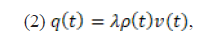
where λ represents the number of lanes.
The equation of conservation is expressed by the following expression:

where L is the section length, qe, qr are the traffic entering the mainstream section and the on-ramp, respectively.
The dynamic of the mean speed is expressed by:

where τ, η and κ are model parameters. The equilibrium speed Ve is defined by [23]:

where vf and ρc are the free-flow speed and the critical density, respectively; a is a model parameter.
In Eq. (4), the first term represents the relaxation, the second term represents the convexion, and the third term represents the anticipation. It has to be noticed that the above equations represent the basis for the conducted numerical simulations. Equation (5) defines the so-called fundamental diagram shown in Fig. 2.
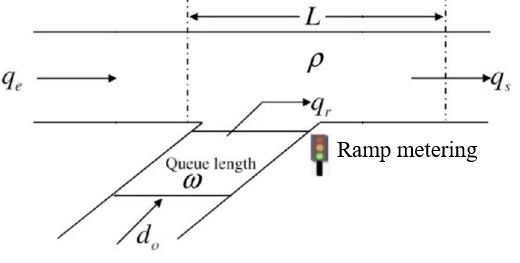
Figure 1. Freeway ramp metering principle
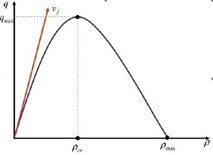
Figure 2. Fundamental diagram
The aim of ramp metering consists on the regulation of the on-ramp flow (using traffic lights) in order to maintain the traffic density at the mainstream segment below a critical one ρcr.
- Flatness-based and model-free control
3.1. Differential flatness
Since their introduction more than thirty years ago [24], differentially flat systems have met with great success in control engineering and other fields, such as pure physics [25, 26]. The main principle of this concept can be summarized as follow (interested readers can find more information and theoretical foundation in [27]):
– any system variable z may be expressed as a differential function of the component of the flat output and their derivatives up to some finite order v, i.e.:

– any component of the flat output may be expressed as a differential function of the system variables;
– the components of the flat output are differentially independent, i.e., they are not related by any differential relation.
Assigning time functions to y1,…,ym yields time functions to any system variable without any integration procedure. An open loop control strategy is provided by this, along with allowance for a reference trajectory.
3.2. Model-free control
Faced with the difficulty of obtaining mathematical models for complex systems, Fliess and Join have introduced a new concept in control engineering where the notion of ultra-local model plays an important role. Indeed, consider the SISO (single-input single output) system and replace the poorly known plant and disturbance by the following ultra-local model:

where y and u are the output and control variables, respectively; the constant α ∈ R is often chosen by a practitioner; F, which subsumes all the unknown structure of the studied system including external perturbations, is estimated via algebraic manipulations and the application of the inverse Laplace transform on the interval [0, T] (see e.g. [17] for more explanations). In the time domain, the following data-driven real-time estimator is obtained:

3.3. Ramp metering algorithm
Consider the freeway section of Fig. 1. A natural flat output, derived from Eq. (2) with λ = 1, is the traffic density ρ. From the principle of the flatness, the open loop control reads:

The trajectory generation is made using a polynomial interpolation. This is accomplished by prescribing the following desired trajectory for the flat output ρ:

where σ(t,0,T) is a polynomial function of time, exhibiting a sufficient number of zero derivatives at times, 0 and T, while also satisfying: σ(0,0,T) = 0 and σ(T,0,T) = 1.
The control loop is closed thanks to the intelligent controller stemming from model-free control principle

where:
– e(t) = ρ(t) – ρ*(t) is the tracking error;
–  stands for the classic controller
– KP, KI and KD are tuning gains.
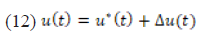
The final control algorithm reads
- Computer simulations
Consider for the computer simulations the section of the North of France freeway A25. The traffic demands at the mainstream and the on-ramp are depicted in Fig. 3. In the no control situation and particularly during the rush hours, around 8 and 10.30 AM, the traffic density increases overhead the critical one. This leads to a formation of congestion and mean speed drop (See e.g. Fig. 4).
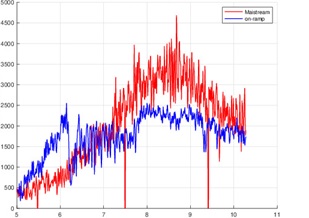
Fig. 3. Traffic demands in vehicles per hour
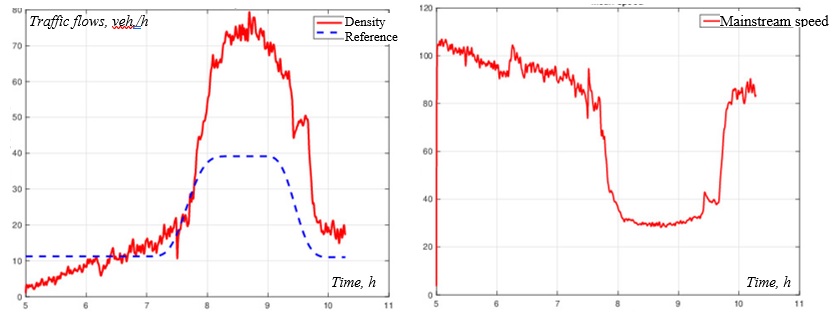
Figure 4. Traffic density and mean speed – no control case
In the no-congestion mode, there is no need for control, the profile of the critical density (the reference) is then low. The controller adapts the density profile to the critical value as soon as traffic becomes dense. Fig. 5 shows significant improvement in traffic conditions.
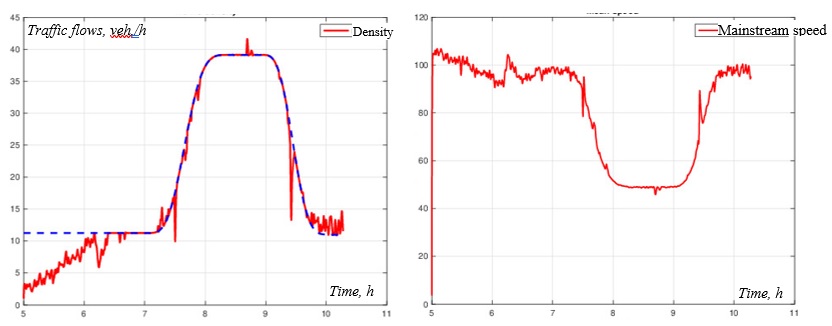
Figure 5. Traffic density and mean speed – control case
Conclusion
The combination of flatness and model-free control seems to be an interesting solution for dynamic ramp metering. Instead of the use of ML techniques which are tedious to implement and require the use of a large amount of data, the application of model-free control and the estimation methods based on algebraic techniques provides an efficient and easy to implement ramp metering approach. This approach enables the dichotomy between the necessity of a model for traffic simulation and the need for a simple, efficient control algorithm to be resolved. However, further investigation must be conducted in order to deal with coordinated ramp metering as well as integrated traffic control where combination with variable speed limits and dynamic traffic routing play an important role.
REFERENCES
[1] CHAVOSHI, K., KOUVELAS, A., Nonlinear Model Predictive Control for Coordinated Traffic Flow Management in Highway Systems. European Control Conference (ECC), St. Petersburg, Russia, 2020, pp. 428 – 433, IEEE, doi: 23919/ECC51009.2020.9143962.
[2] ELEFTERIADOU, L., An Introduction to Traffic Flow Theory. 2nd, Springer, 2024, 353 pp., ISBN 978-3-031-54029-5.
[3] GHOSH, S., LEE T.S., Intelligent Transportation Systems: Smart and Green Infrastructure Design. 2nd, CRC Press, 2010, 218 pp., ISBN 9781439835180.
[4] KACHROO, P., ÖZBAY, , Solution to the User Equilibrium Dynamic Traffic Routing Problem Using Feedback Linearization. Transportation Research Part B: Methodological, Elsevier, vol. 32(5), pp. 343 – 360, ISSN 0191-2615, https://doi.org/10.1016/S0191-2615(97)00031-3.
[5] MAMMAR, S., Systèmes de transport intelligents: Modélisation, information et contrôle. Hermes Science Publications, 2007, 360 pp., ISBN 978-2-746-21519-1.
[6] HEGYI, A., Model Predictive Control for Integrating Traffic Control Measures. TRAIL Thesis Series T2004/2, The Netherlands TRAIL Research School, 2004, 232 pp., ISBN 90-5584-053-X.
[7] KACHROO, P., ÖZBAY, K., Feedback Ramp Metering in Intelligent Transportation Systems. Springer Science+Business Media New York, 2003, 333 pp., ISBN 978-1-4613-4737-8.
[8] KOTSIALOS, A., PAPAGEORGIOU, M., Nonlinear optimal control applied to coordinated ramp metering, IEEE Transactions on Control Systems Technology. 2004, 12/6, pp. 920 – 933, ISSN 1063-6536.
[9] BLANDIN, S., WORK, D., GOATIN, P., PICCOLI, B., BAYEN, A., A general phase transition model for vehicular traffic. SIAM J. Appl. Math., 2011, 71(1), pp. 107 – 127, ISSN 1095-712X, doi:2307/41111580.
[10] CHOWDHURY, D., SANTEN, L., SCHADSCHNEIDER, A., Statistical physics of vehicular traffic and some related systems, Physics Rep., Vol. 329/4-6, 2000, pp. 199 – 329, ISSN 0370-1573, https://doi.org/10.1016/S0370-1573(99)00117-9.
[11] SIRI S., PASQUALE, C., SACONE, S., FERRARA A., Freeway traffic control: A survey. Automatica, Vol. 130(5):109655, 2021, ISSN 0005-1098, doi:10.1016/j.automatica.2021.109655.
[12] HAJ-SALEM, H., BLOSSEVILLE, J.-M., DAVÉE, M., PAPAGEORGIOU, M., Alinea: Un outil de régulation d’accès isolé sur autoroute – Étude comparative sur site reel. Rapport INRETS, No 80, Arcueil, 1988, 95 pp., ISBN 2857822421.
[13] SMARAGDIS E., PAPAGEORGIOU, M., KOSMATOPOULOS, E., A flow- maximizing adaptive local ramp metering strategy. Transportation Research Part B: Methodological, Elsevier, vol. 38(3), pp. 251 – 270, ISSN: 0191-2615, https://doi.org/10.1016/S0191-2615(03)00012-2.
[14] HAN, Y., WANG, M., LI, L., RONCOLI, C., GAO, J., LIU, P., A physics-informed reinforcement learning-based strategy for local and coordinated ramp metering. Transportation Research Part C: Emerging Technologies, Vol. 137/ 103584, 2022, ISSN 0968-090X, https://doi.org/10.1016/j.trc.2022.103584.
[15] DELALEAU, E., JOIN, C., FLIESS, M., Synchronization of Kuramoto oscillators via HEOL, and a discussion on AI. 11th Vienna International Conference on Mathematical Modelling (MATHMOD 2025), Feb 2025, Vienna, Austria. pp. 229 – 234, https://doi.org/10.48550/arXiv.2501.07948.
[16] ABOUAÏSSA, H., FLIESS, M., JOIN, C., On ramp metering: towards a better understanding of ALINEA via model-free control, International Journal of Control, 2017, 90 (5), pp.1018 – 1026, ISSN 1366-5820.
[17] FLIESS, M., JOIN, C., Model-free control. International Journal of Control, Vol. 86/12, pp. 2228 – 2252, 2013, ISSN 1366-5820, https://doi.org/ 1080/00207179.2013.810345.
[18] FLIESS M., JOIN C., Machine learning and control engineering: The model-free case, Future Technologies Conference FTC 2020, Vancouver, Canada, Proceedings, Vol. 1, 2020, pp. 258 – 278, ISSN 2194-5357, doi 10.1007/978-3-030-63128-4_20.
[19] PAYNE, H., Models of traffic and control. Simulation Council Proc. Math. Models Public Syst., vol. 1, chap. 6, 1971, pp. 51 – 61, ISSN 0037-5497.
[20] PAPAGEORGIOU, M., BLOSSEVILLE, J.-M., HADJ-SALEM, H., Modelling and real-time control of traffic flow on the southern part of boulevard peripherique in Paris – Part I: Modelling. Research A, 1990, 24, pp. 345 – 359, ISSN: 1878-3813, DOI: 10.1016/0191-2607(90)90048-B.
[21] SPILIOPOULOU, A., KONTORINAKI, M., PAPAGEORGIOU, M., KOPELIAS, P., Macroscopic traffic flow model validation at congested freeway off-ramp areas. Transportation Research Part C, 41, 2014, pp. 18 – 29, ISSN: 1879-2359.
[22] MESSEMER, A., PAPAGEORGIOU M., METANET: A Macroscopic Simulation Program for Motorway Networks. Traffic Engineering and Control, Vol. 31(8), 1990, pp. 446 – 470, ISSN: 0041-0683.
[23] MAY, A., Traffic Flow Fundamentals. Prentice Hall, Englewood Cliffs, NJ, 1990, 474 pp., ISBN: 0-13-926072-2.
[24] FLIESS, M., LÉVINE, J., MARTIN, P., ROUCHON, P., Sur les systèmes non linéaires différentiellement plats. C. R. Math. Acad. Sci. Paris 315, 1992, no. 5, pp. 619 – 624, ISSN 1778-3577.
[25] FLIESS, M., LÉVINE, J., MARTIN, P., ROUCHON, P., Flatness and defect of non-linear systems: introductory theory and examples. Int. J. Control 61, 1995, no. 6, pp. 1327 – 1361, ISSN 1366-5820.
[26] FLIESS, M., LÉVINE, J., MARTIN, P., ROUCHON, P., Deux applications de la géométrie locale des diffiétés. Ann. Inst. Henri Poincaré, Phys. Théor. 66, 1997, no. 3, pp. 275 – 292, ISSN 0246-0211.
[27] SIRA-RAMÍREZ, H., AGRAWAL, S., Differentially flat systems. Marcel Dekker, New York, 2004, 488 pp., ISBN 0824754700.
Hassane Abouaïssa, Assoc. Prof., HDR
ORCID iD: 0000-0002-0017-4110
Laboratoire de Génie Informatique et d’Automatique de l’Artois (LGI2A), Artois University,
UR 3926, F-62400 Béthune, France
E-mail: hassane.abouaissa@univ-artois.fr
Prof. Dr. Vasil Dimitrov
ORCID iD: 0000-0001-8206-7521
Department of Electrical Equipment in Railway Transport, Todor Kableshkov University of Transport
158, Geo Milev St., 1574 Sofia, Bulgaria
E-mail: vdimitroff@vtu.bg

Свързани статии:
 Analysis of the Average Speeds of Passenger Trains in Bulgaria on the Main Railway Routes, according to the Annual Train Schedule for 2025
Analysis and Challenges for IoT & AI in Building and Implementing Smart Rail Transport Systems
Study of Brushless Motor Control Methods Based on ai Algorithms
Type Synthesis of Guidance Mechanisms with a Four-bar Topological Structure
Analysis of the Average Speeds of Passenger Trains in Bulgaria on the Main Railway Routes, according to the Annual Train Schedule for 2025
Analysis and Challenges for IoT & AI in Building and Implementing Smart Rail Transport Systems
Study of Brushless Motor Control Methods Based on ai Algorithms
Type Synthesis of Guidance Mechanisms with a Four-bar Topological Structure